Silent Drift: When the Outside World Changes and Your Team Doesn't Notice
Fusionstek Research
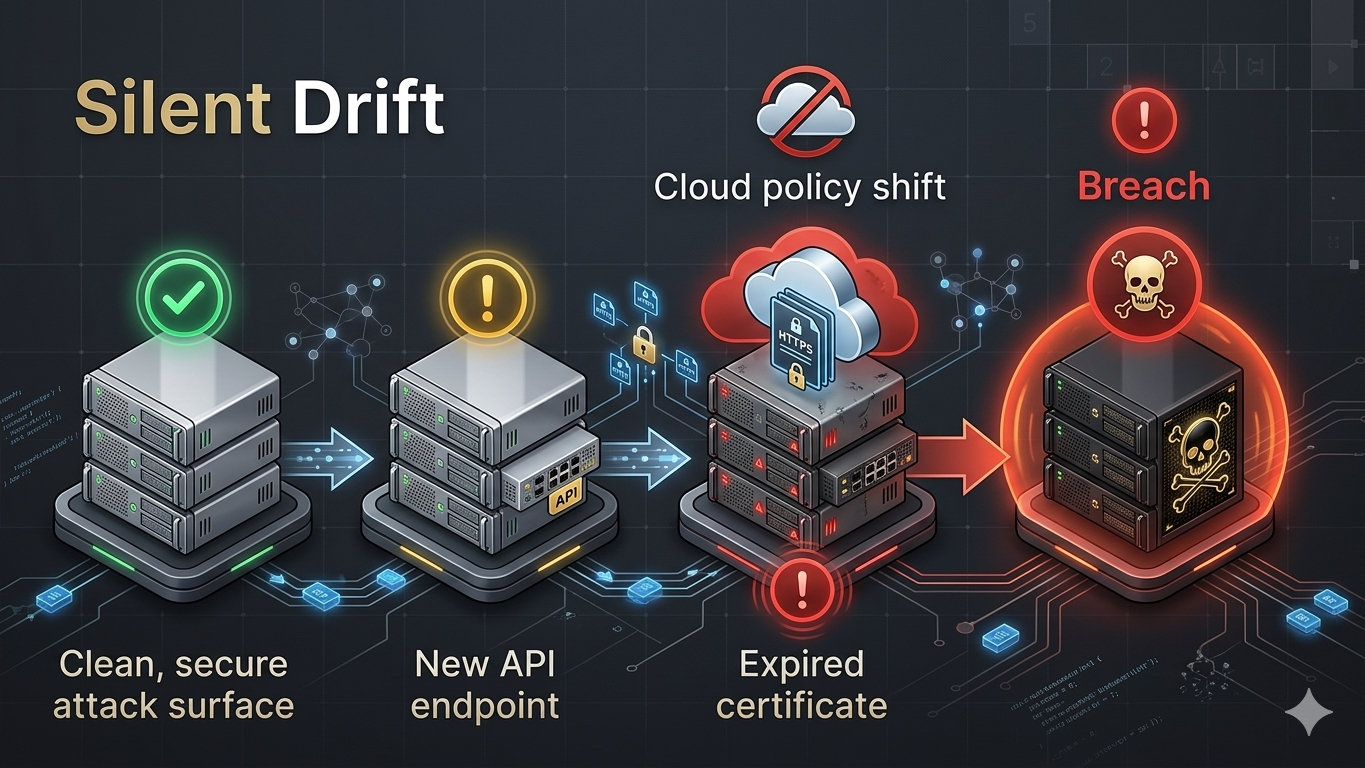
Silent drift is what happens when the outside world changes and your team never notices. It is not the same as "we saw a change and decided to accept it." It is change that occurs externally — new subdomains, public endpoints, expired certificates, cloud policy shifts, decommissioned assets, or vendor-side updates — without any corresponding internal visibility or response. By the time an incident occurs or an auditor asks what was exposed when, the evidence trail is missing because the organisation was never looking.
For internet-facing environments, change is constant. The question is whether you observe it. If you rely on one-off scans or infrequent refreshes with no comparison to a known baseline, you are not detecting drift; you are taking snapshots that go stale the moment the next change happens. Silent drift is the accumulation of those unobserved changes. It is the gap between "we have an EASM report" and "we can show what changed against a baseline."
What silent drift actually is
Silent drift is any material change to your external attack surface that occurred without the team observing, classifying, or responding to it. That includes new exposure (a subdomain, endpoint, or cloud-attributed asset that appeared and was never added to your map), removals, ownership and routing shifts, technology stack changes that affect risk relevance, and perimeter-first third-party exposure changes.
The defining characteristic is lack of visibility. The change happened; your assurance and risk view did not update. So when regulators, insurers, or customers ask what changed and when, you cannot answer with evidence. That makes review harder and weakens the due-care story, not only operations.
From External Change to Unnoticed Exposure
Change happens outside your view. Without a baseline and regular comparison, the team stays unaware until an attacker, auditor, or reviewer sees the new reality.
- 1
External Change
A new public endpoint, DNS update, expired certificate, cloud policy shift, or vendor change happens on the internet. Nobody inside the organisation is necessarily notified.
- 2
No Baseline Comparison
There is no refresh run, or the refresh is not compared to a verified baseline. So 'what changed' is never computed and never surfaced.
- 3
Team Stays Unaware
Dashboards and reports still reflect the old snapshot. No alert, no ticket, no evidence that the change occurred. The external surface has already moved on.
- 4
Risk and Assurance Gap
Attackers or reviewers see the new reality. Your assurance story still assumes the old surface. Silent drift is the gap between what you think is true and what is actually exposed.
Why it happens
Silent drift persists for a few recurring reasons. First, there is no baseline refresh — only periodic or one-off scans. Without a baseline and a disciplined refresh-and-compare cycle, "what changed" is never computed. Second, ownership is fragmented: cloud, infra, product, and vendors all make changes that affect the external surface, and no single team sees the full picture. Third, change often happens outside the normal release process: a DNS update, a cloud console tweak, a SaaS setting, or an expired certificate. Those changes do not always show up in change tickets or deployment logs. Fourth, tools that only produce point-in-time reports, with no diff or drift output, leave teams with a false sense of completeness. The report looks finished; the surface has already moved.
Why one-off scans hide it
A single scan tells you what was true at one moment. It does not tell you what changed the next morning or the next week. If you do not compare that record to what happens next, you cannot answer the questions that matter after an incident or an audit: what changed since the last verified state? Was the new exposure intentional, temporary, or forgotten? How long did the change remain externally reachable? Did the organisation notice and respond in time? That is the gap between "we scanned" and "we continuously operated with reasonable care." One-off scans create false confidence: the report looks finished, but the external surface has already started changing underneath it.
What attackers see that defenders often do not
Attackers re-enumerate. They run subdomain discovery, endpoint discovery, and certificate transparency checks on a schedule. When a new API or a forgotten dev subdomain appears, they may see it quickly. When a certificate expires or a cloud-attributed asset becomes exposed, their tools may flag it. Their map of your surface can become fresher than your own. Silent drift is the set of changes they can see before you have recorded them in your assurance baseline. The result is that your understanding of "what we expose" lags reality, and incident and audit timelines become harder to explain.
Categories of silent drift that matter
Not every change is equally security-relevant, but these categories are worth watching explicitly:
- New exposure: New subdomains, URLs, public endpoints, or cloud-attributed assets that appear without being added to your asset map or risk review.
- Removals: Something that was there is gone. Was it decommissioned on purpose, or did it fail, move, or get hijacked? Without drift detection, you may not notice until someone asks.
- Ownership and routing: DNS record changes, TLS/certificate changes, or CDN shifts that alter who controls an asset or how traffic is routed.
- Technology stack changes: New frameworks, CDNs, or platforms that change risk relevance or validation confidence.
- Third-party and vendor surface: Changes to SaaS, APIs, or partner integrations that expand or alter your perimeter-first external footprint.
How silent drift breaks assurance and due care
Regulators and insurers increasingly expect evidence of security oversight. They want to know what was exposed, when it changed, and what you did about it. Silent drift means you did not know. There is no evidence of the change, no review, and no remediation record — because the organisation was never alerted. That weakens due-care narratives and makes review harder. NIST SP 800-137 reinforces that security-relevant change has to be monitored and assessed over time, not captured once and treated as static truth (NIST SP 800-137).
How to surface it
Silent drift is only "silent" if you do not look. The operational fix is to establish a verified baseline of your external surface and then run controlled refreshes against it. The diff between baseline and refresh is drift. Done properly, drift detection classifies changes — new exposure, regression, confirmed removal, or noise — and attaches evidence: what changed, when it was first observed, and how it was verified. Run-quality logic matters: if a refresh was degraded or partial, a "removal" might be a missed observation, not a real decommission. So good drift programmes separate refresh trust from posture and promote only meaningful, explainable changes into review queues.
What teams should do next
- Establish a verified baseline from an assurance-capable scan, not just any run.
- Run refreshes on a schedule and compare them to the baseline so drift is computed and classified.
- Treat "we did not observe a change" differently from "we did not check" — so silence is not mistaken for stability.
- Feed drift into review and remediation workflows so new exposure and regressions get tickets and evidence.
- Keep evidence for what changed, when it changed, and how it was verified, for auditor and insurer review.
Why this belongs in an assurance programme
Silent drift is the gap between having an EASM report and having evidence-backed visibility over what changed. It is not a nice-to-have to "also" do drift detection. It is a practical way to turn external security into an operating model instead of a point-in-time snapshot. When the outside world changes and your team does not notice, risk accumulates and due care erodes. Baseline plus refresh plus explainable drift is how you notice and document the record.