External assurance breaks down when teams can discover issues but cannot show what happened next. A due-care timeline is the operating record for that loop: what was seen on the public surface, what you did about it, whether you verified the fix, and whether it came back. That is action and verification first — not a separate compliance product.
When leadership, insurers, auditors, or customers later ask “How do you know that issue was fixed — and that you kept watching?”, you should not rebuild the story from tickets and screenshots. You point to the same dated chain your team already ran. That is evidence you can defend — because it reflects work your team actually performed.
What a due-care timeline is
A due-care timeline is a structured, dated history tied to each material finding on your external surface. Each entry should answer:
- Asset — which host, domain, endpoint, or service was in scope.
- Time — when the issue was first seen, reassessed, or closed.
- Evidence — what test or verification step produced the record.
- Outcome — remediation recorded, verification passed, regression detected, or accepted risk with rationale.
In plain terms: your team acts on validated external risk, verifies outcomes where the program requires it, and the timeline preserves the record. “Due care” in legal language means acting as a reasonable organisation would — not perfect security. Reasonableness is shown with records: you knew about exposure, you acted in line with risk, and you can show when you checked again.
Action and verification on the public surface
A one-off scan answers “what did we see once?” A due-care timeline answers “what did we do about it over time?”
- Action — prioritize, assign, remediate, or accept risk with documented rationale on material findings.
- Verification — follow-up checks that close the loop (or show the issue returned).
- Defend — export or walk through the same chain when review is required, without inventing a second narrative.
From daily operations to the same record at review
The diagram below is how those pieces fit together in practice — not a separate compliance workflow.
Operate daily. Discovery, monitoring, and remediation on your internet-facing surface are ongoing security work: refresh what is exposed, track material findings, assign and close remediation, re-check when something may have regressed. That is what the top of the diagram labels regular discovery, monitoring, and remediation.
Structured evidence per finding. The center panel is one example chain: a test and finding on a named asset (for example a payment gateway), the date it was seen, the verification step that confirmed a fix, and the date remediation was recorded. That is the security operations record auditors and insurers are really asking for when they say “what was tested, when, what was done, what was re-checked?”
Export when review is required. The evidence step is not a different program — it is the same timeline your team already built, packaged for audit, insurance renewal, customer security review, or leadership when they need dated proof. The bottom timeline (Aug through Dec, with markers on the dates that matter) is that single chain over time — not a second story assembled after the question arrives.
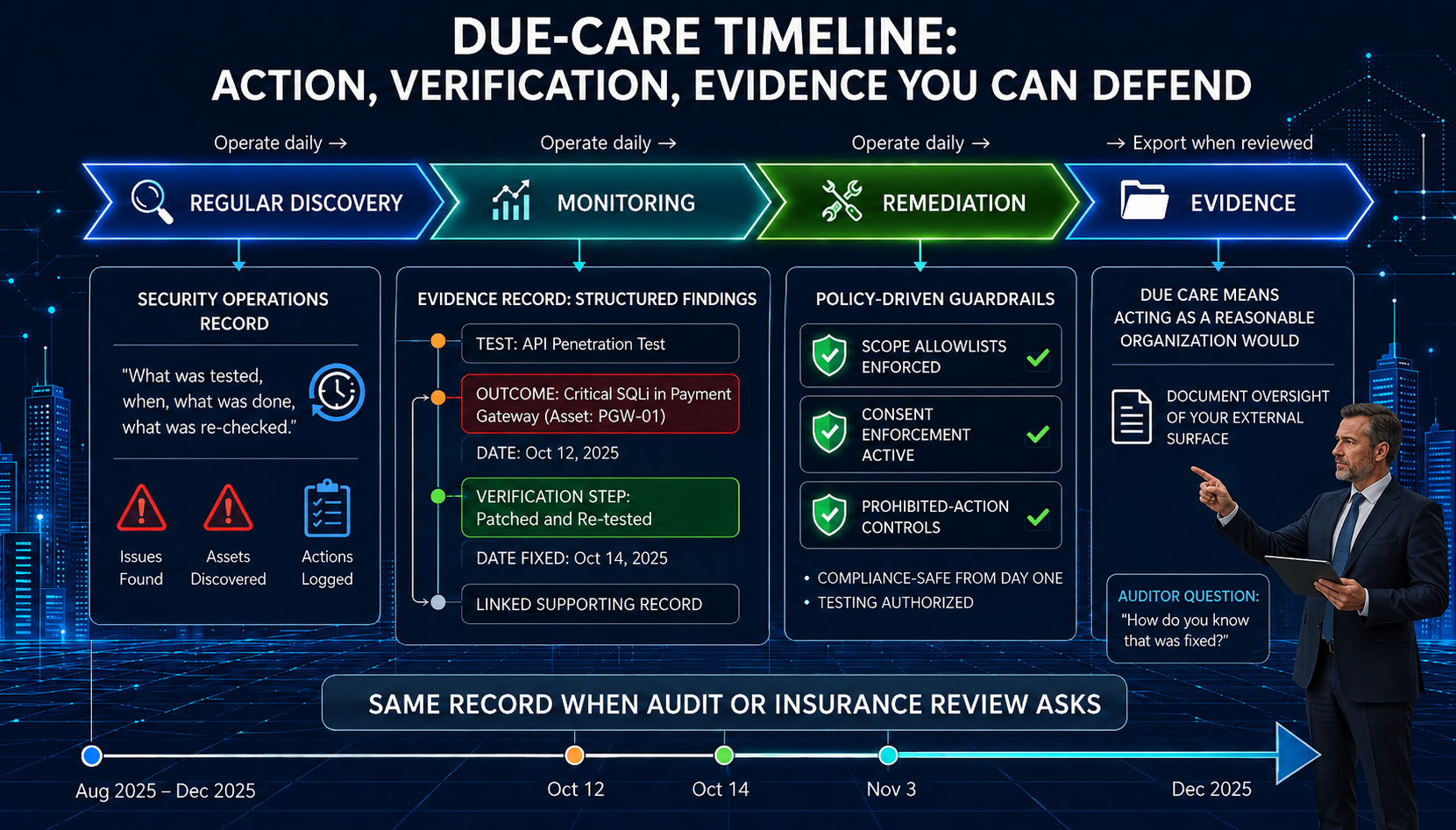
Read the diagram top to bottom: daily discovery, monitoring, and remediation feed a structured record per finding; scope and consent guardrails (right) keep testing authorized; the dated timeline along the bottom is the same record you use when audit or insurance review asks how you know an issue was fixed.
Policy-driven guardrails — why they belong in the same story
Assurance fails if testing oversteps what you authorized. Scope allowlists, consent enforcement, and prohibited-action controls — shown on the right of the diagram — keep discovery and assessment inside agreed boundaries. That matters operationally and in review: insurers and regulators care whether representations in applications and policies match reality. Authorized, in-scope testing makes the timeline defensible — not just complete.
Fusionstek’s due-care view supports the full loop: filter by latest scan, a selected scan, or customer history; tie events to assets and findings; export alongside executive and technical reports for day-to-day operations and review when needed.
Why point-in-time reports fall short
A single scan or report is a snapshot. Internet-facing assets change — new subdomains, certificate rotations, cloud drift, third-party dependencies. Teams need to detect change, act, and re-check, not only assess once. The timeline is how you show that work happened between assessments — for your own queue discipline and for anyone who asks later.
What good evidence looks like (operator checklist)
Whether you are closing findings this week or preparing for renewal, audit, or a board update, the same fields matter:
- Discovery and refresh cadence — proof the external inventory was updated on a defined schedule or after material change.
- Validated findings — what was confirmed vs. what still needs review (avoid mixing confirmed issues with candidates).
- Remediation and verification — who acted, when, and whether a follow-up check closed the loop.
- Regression visibility — if an issue returned, when it was seen again.
- Authorized scope — evidence that testing stayed within agreed targets and rules (see below).
When audit, insurance, or regulators ask — what they are really asking for
Regulators and supervisors want security run as an ongoing program, not a once-a-year exercise. Public companies must describe how they assess and manage material cyber risks, and how the board and management oversee those risks and stay informed about incident prevention, response, and remediation (SEC Reg S-K Item 106 (17 CFR § 229.106); SEC cybersecurity disclosure guide) — not day-to-day alert triage, but governance and accountability for the program. Financial institutions under the FTC Safeguards Rule must monitor and test controls (continuous monitoring or periodic penetration testing and vulnerability assessment), reassess risk when the environment changes, and send leadership a written report at least annually on how the program is working (16 CFR § 314.4; FTC Safeguards overview). In New York financial services, Part 500 requires a monitoring process for new vulnerabilities, scans after material changes, and timely remediation prioritized by risk (23 NYCRR § 500.5) — work your security team performs and documents.
EU NIS2 entities must maintain a documented, management-backed risk-management system — not isolated controls — with evidence that measures work, including tests, incidents, and monitoring output (ENISA technical guidance on NIS2 risk-management measures). Auditors routinely ask for timestamped monitoring and remediation history, not a clean screenshot taken on audit day.
Insurers have shifted from “do you have MFA?” on a form to proof controls are deployed, scoped, and current. Brokers such as Marsh align underwriting questions to frameworks like NIST CSF and focus on whether organizations can demonstrate sustained control operation (Marsh US cyber insurance market update). After a loss, carriers often scrutinize whether known issues were identified, prioritized, and remediated — or left as “someone was going to look at it.” Documented timelines support the former story.
Auditors (ISO 27001, SOC 2 Type II, customer security reviews) expect a trail from finding to closure. ISO 27001 requires documented nonconformities, corrective actions, and effectiveness verification (ISO/IEC 27001:2022). SOC 2 Type II examines whether controls operated across an observation period (typically months), not only on the day of the audit — logs, tickets, scans, and re-tests over time. NIST CSF 2.0’s Detect function includes continuous monitoring of assets for adverse events (NIST Cybersecurity Framework 2.0). For external exposure specifically, change outpaces point-in-time reviews; continuous discovery and monitoring are how teams show the surface stayed in scope over time (NIST SP 800-137 — Information Security Continuous Monitoring; external attack surface management overview).
Those frameworks describe the same operational loop in different words. The due-care timeline is how you show you ran it — not a substitute for running it.
Summary
A due-care timeline is action and verification on material external findings, preserved as dated evidence. Your team uses it to close loops and catch regressions; leadership, insurers, auditors, and customers use the same record when they ask what was known and what was done. Fusionstek ties discovery, validated assessment, drift awareness, remediation and verification events, and scope policy into one trail — run day to day, defend when asked.